TRANSITS, THEODOLITES, TOTAL STATIONS, AND LEVELS

This article is to help explain the differences in Transits, Theodolites, Total Stations, and Levels.

Transits 转镜经纬仪
A transit is type of theodolite that features a telescope that can “flip over” which would allow easy back-sighting and doubling of angles for error reduction. Some transit instruments were capable of reading angles directly to thirty arc-seconds. In the last 50 years, transits have been known as a simple form of theodolite with less precision, lacking features such as scale magnification and mechanical meters. The importance of transits has been decreasing since more compact, accurate electronic theodolites have become widespread tools, but transits still find use as a lightweight tool for construction sites. Please note that some transits do not measure vertical angles.

Theodolites 经纬仪 水准仪
A Theodolite is a instrument for measuring both horizontal and vertical angles, as used in triangulation networks. It is a tool used in the surveying and engineering industry, but theodolites have been adapted for other specialized purposes as well. A theodolite consists of a telescope mounted movably within two perpendicular axes, the horizontal or trunnion axis, and the vertical axis. When the telescope is pointed at a desired object, the angle of each of these axes can be measured with great precision, typically on the scale of arcseconds. The measurements are typically recorded by hand as they are not recorded by a computer or data collector.

Total Stations 全站仪
A total station is an optical instrument used in modern surveying. It is a combination of an electronic theodolite (transit), an electronic distance measuring device (EDM) and software running on an external computer, such as a laptop or data collector.

Levels 水平尺
The builder’s level is often mistaken for a transit, but is actually a type of inclinometer. It measures neither horizontal nor vertical angles. It simply combines a bubble level and telescope which allows the user to visually establish a level line of sight along a plane.

Other Equipment

laser topographic position finder 激光地形仪
laser plummet apparatus 激光铅垂仪
Disto 激光测距器
GPS receiver
laser swinger 激光扫平仪


What is Building Control?

What is Building Control?

All building work carried out should meet current building codes and regulation requirements. Our Building Control Service ensures that buildings are designed and constructed in accordance with the Building Regulations and associated legislation.

Please Note: It is the responsibility of those carrying out the work to ensure that the provisions of the regulations are fully met. The role of Building Control is only to check that they do so.

Ten essential functions of Building Control

  • Encourage innovation to produce energy efficient and sustainable buildings
  • Support local, regional and national businesses
  • Educate and inform building professionals, contractors and trades people
  • Defend vulnerable communities and householders
  • Drive out rogue traders
  • Safeguard the investments of individuals and companies
  • Enhance access for disabled, sick, young and old people
  • Protect the community from dangerous structures
  • Provide advice in support of the emergency services
  • Ensure sports grounds and public venues are safe for crowds

What is the difference between planning and building control?

It is generally realised that a form of permission is required for building work or alterations of properties. However, it may not always be clear how the Planning and Building Regulations approval regimes differ.

Building Regulations set standards for the design and construction of buildings to ensure the health and safety for people in or around those buildings. They also include requirements to ensure that fuel and power is conserved and that facilities are provided for people, including those with disabilities, to access and move around inside buildings.

Planning seeks to guide the way our towns, cities and countryside develop. This includes the use of land and buildings, the appearance of buildings, landscaping considerations, highway access and the impact that the development will have on the general environment.

For many types of building work, separate permission under both regimes (separate processes) will be required. For other building work, such as internal alterations, Buildings Regulations approval will probably be needed, but Planning permission may not be. You may also have responsibilities under the construction health and safety regulations.

Service Standards

A set of service standards have been produced to provide information on what you can expect from the Building Control service.

  • Most building control officers hold a relevant qualification, which cover a wide range of disciplines including surveying, structural engineering, public health and fire engineering. There are many years of experience available to call on and our officers regularly attend training courses to ensure that they are up to date with modern methods of construction. A multi-functional service is offered covering structures, fire precautions, services, drainage and where appropriate liaison with other council departments may be carried out to offer a team approach
  • A progressive approach is adopted to help you obtain the best possible value for money. We will consider all new methods and materials of construction, based on our own experience and, if necessary, other expert advice
  • Maximum use of new technology is made and state of the art software to check engineer’s calculations as well as other aspects of the proposed work such as heat loss from buildings and energy (SAP) ratings of new buildings may be utilised to ensure a speedy and accurate response
  • Extensive records on properties are maintained so that future owners can plan further works with confidence. This also means that prospective purchasers can ensure that work carried out in the past has been inspected and approved. This information can also be analysed to give prior warning of any potential problems particularly in relation to ground conditions
  • Close liaison is maintained with building control offices in other local authorities through the District Surveyors Association to share our experience and exchange knowledge and information on a national level

Building regulations see http://www.haringey.gov.uk/planning-and-building-control/building-control/building-regulations

http://www.legislation.gov.uk/uksi/2010/2214/pdfs/uksi_20102214_en.pdf


HOUSETYPES AND BUILD METHODS

Four mainstream build methods in the UK:

  • Traditional Masonry Construction
  • Modern Methods of Construction
  • Structural Insulated Panels (SIPs)
  • Timber Frame Construction

Traditional Masonry Construction

Image result for cavity wall

Modern Methods of Construction

These can include Structural Insulated Panels (SIPs), Timber Frame, Off-site manufactured – volumetric, Off-site manufactured – panellised etc.

Structural Insulated Panels (SIPs)

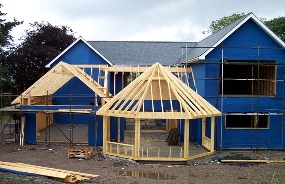
The way we build houses is changing. With environmental issues likely to dominate all our lives for the foreseeable future, the building industry is moving to adapt new technologies which will lead to the building of a brand new type of environmentally friendly and energy-efficient housing. Structural Insulated Panels (SIPs) provide the ideal solution for those clients who want to create an airtight building with exceptional levels of thermal insulation and are the ideal wall choice for achieving all levels of the Code For Sustainable Homes (CfSH). Because of their superior strength, SIP homes are constructed using less timber than is required for a traditional timber frame. This results in an external envelope with few thermal bridges. Minimal thermal bridges combined with high quality polyurethane core results in very low U values in comparison with other forms of construction. SIP panels are assembled using adhesives and sealants to glue the components together. This results in a very airtight structure. Because of the way they are assembled SIP homes are able to achieve their required air tightness prior to wall finishing`s being fixed. SIP panels are suitable for walls as well as roof structures and are ideally suited to projects with room in the roof design. SIP panels are made from Orientated Strand Board (OSB3) facing boards with a CFC free/ODP zero closed cell polyurethane core.

  SIPS is a building system which will speed up the construction process as well giving us homes and buildings that are ready for 21st century living. With its unique insulating properties SIPS allow you to reap a number of major benefits throughout the construction process and for many years after a building has been completed. SIPs are available in a variety of thickness to meet the ‘U’ value and roof spans required. They range from 100mm to 250mm thick and can be a direct replacement for the internal skin of the cavity wall – see the applications below for general construction elements.

Selfbuildplans can design your house as a full SIP structure with or without the roof. All of Selfbuildplans house types can be easily adapted to accommodate SIPs and we can provide a full pack of comprehensive SIP construction drawings ready for your builder to follow – Please contact us for more details.

Advantages

  • Exceptional thermal properties
  • Lower heating bills
  • Very airtight building
  • Environmentally friendly
  • Lightweight building material
  • Fastrack erection (small or large format)
Applications: Standard Brickwork Cavity Wall Applications: Standard Rendered Cavity Wall

Applications: Cladding Applications: Roof

Timber frame Construction

As its name implies, timber frame construction is a method of building that relies on the natural resource of timber to provide the basic means of structural support. Timber has many properties which we believe is the best material for construction in a modern day environment. Timber contains less embodied energy than comparable building materials and is possibly the only renewable structural building material available today thus making timber the leader in an industry that is continually promoting the need for higher levels of energy efficiency and sustainability. All of our house designs can be quickly amended to timber frame or purchased directly for conversion by your timber frame supplier, who would usually complete a bespoke design from any of the house plans we offer. Just inform us of your favourite plan and selfbuildplans can liaise directly with your chosen timber frame supplier to obtain a full cost base for the structural timber frame. This will give you certainty in your costs before you commit to purchase any plans from us. Please contact us for more information.

http://www.timber-frame-suppliers.co.uk/about-timber-frame/

Base layer materials

Materials used to build a path base layer are generally well graded granular sub base materials which help to spread the weight and forces of different path users in to formation layer below. The base layer can be built with one type of material or in combination with another type. For example, the lower half of the base layer can be built with a lower quality material such as crushed concrete (demolition waste), whilst a higher quality material like Type 1 granular sub base is used on the top half to remove all irregularities before laying the surface layer.

Well graded granular sub base materials can be:

  • Natural aggregates
  • Recycled aggregates
  • Secondary aggregates

Natural aggregates

The Department of Transport ‘Specification of Highway Works’ (SHW) defines a number of well graded aggregates based on the composition of particle sizes contained in the commercially produced mixture. Clause 803 defines ‘Department of Transport (DTp) Type 1 granular sub base’ and Clause 804 describes ‘DTp Type 2 granular sub base’. These aggregates are more commonly referred to as ‘Type 1’ and ‘Type 2’.

Type 1

This is the most common well graded granular sub base material used to construct a path’s base layer. It is a well tried and tested component of lowland paths that has been used for many years as the default base layer material. Commercial quarries supply DTp Type 1 granular sub base consisting of crushed rock graded to a specification that has a defined proportion of stone particle sizes. Well graded Type 1 contains a good mix of angular aggregate sized between 63mm and ‘fines’ (sand sized particles), however, most of the aggregate content is less than 32mm in size – the European Norm standard for Type 1 is 0/32. The solid stone particles should not exceed 63mm in size and less than 9% of fines. This ensures the material has an acceptable level of natural interlock between the angular aggregate particles and no voids once compacted. Type 1 is subject to regional variations based on geology – most quarries in central, west and south Scotland produce it from grey whinstone, a few quarries in eastern Scotland produce it from reddish whinstone, and further north it is produced from granite.

type 1 aggregate

Type 2

Like Type 1, this is crushed rock less than 32mm in size with less than 9% ‘fines’ but with no specified grading. It usually contains finer material than Type 1, being composed of fewer angular aggregate sizes. Type 2 is not as strong as Type 1, so for that reason, it is not generally used on its own to build a base layer. It would usually be used to form the lower part of a base layer with Type 1 laid on top.

type 2 aggregate

Type 3

Another crushed aggregate with a lower ‘fines’ component than Type 1 or Type 2 – there should be less than 5% ‘fines’ and over half of the aggregate particles are greater than 4mm in size. This uniformly graded aggregate material is suitable for a free draining base layer for porous surfaced paths.

type 3 aggregate

Crusher run

This granular sub base is a waste material from quarry stone processing. It is crushed material that comes straight off the rock crusher after the first crushing stage, which is not carried forward to sieving stage. It is similar to scalpings, its strength is variable, and is available in different maximum particle sizes, based on the screen sizes used on the rock crusher, which means there is no guarantee that the waste material is well graded. Providing that the rock crushed is not too soft, crusher run can be used as an alternative to Type 1 or Type 2.

crusher run aggregate

Scalpings

This is a waste material from quarry explosions which is removed (sieved out) before the larger rock is crushed. It is often referred to as quarry waste, its strength can be variable and there is no guarantee that its well graded. It is often much cheaper to purchase than the other granular sub base materials because of quality issues. Particles range in size from 100mm – 40mm to dust. Scalpings can be used as fill material to make up the formation level where it has been excavated deeper than originally specified to deal with soft spots. It can also be laid as the lower part of a base layer with Type 1 on top. If carefully selected, scalpings may make a reasonably good base layer when used on their own, but avoid wet material with high clay content. It can cause problems.

scalpings

‘As dug’

This granular sub base material should consist of free draining, naturally occurring sands and gravels with sufficient clay content to bind the material together when compacted. It is sometimes referred to as ‘hoggin’. Such materials are usually glacial tills found mainly in glaciated areas and river valleys. ‘As dug’ material is taken straight out of the ground from small scale borrow pits alongside the route being built, and has not been crushed or graded to any specification. It can also be imported to site from one large borrow pit where onsite materials are not suitable for path construction.

‘As dug’ materials can be used to provide the bulk of a base layer, which can then be overlaid by a regulating layer of higher quality Type 1 on which the path surface can be laid. To improve the quality of the ‘as dug’ material it can be graded on site using a portable non-vibrating screener attached to the dumper or a larger mobile vibrating screener. The latter is suitable where good access is available.

‘As dug’ materials may be the only source of stone in some areas where it is impractical or prohibitively expensive to import commercially quarried aggregates. These situations could include small scale upgrades, or particularly remote locations. However, if the range and composition of particle sizes would result in a poor quality path, such as too much clay or soft rock, it is worth investigating other options before settling for ‘as dug’ material.

hoggin

Recycled and Secondary aggregates (RSA)

In recent years there has been an increase in the availability and use of recycled aggregates and re-useable by-products from industries. They tend to be locally available and the quality can vary greatly, but recycled and secondary aggregate quality standards are now available. In many cases it will be necessary to use RSA along with conventional path construction materials. A useful information resource about RSA is available onAggRegain – a complete online guide to sustainable aggregates.

Typical recycled aggregates are road planings (from road re-construction or maintenance) and crushed concrete (from demolition waste). All recycled and secondary aggregate products should be chosen carefully. Industrial by-products that do not form a specified standard aggregate mixture design must be individually assessed, because some materials are prone to leaching or just not suitable for construction.

Demolition waste

Recycled Type 1, Type 2 can be produced from a variety of materials arising from demolition waste (crushed concrete, brick, hardcore) from buildings or other structures. However, quality can be variable so check the specification with the supplier before purchasing the material – check for a well graded size distribution. Recycled demolition wastes can make good bottoming or lower half of the base layer with Type 1 laid on top. Some path base layers have been successfully built using just recycled Type 1 where the material has been well graded to the specified quality standard.

type1 recycled demolition waste

Road planings

These are crushed or milled bitmac or asphalt arisings produced in road or pavement reconstruction or maintenance work. This material has similar properties to well graded aggregate. If rolled hard in hot weather, the bitumen binder can soften and then re-bind the bitumen coated stone to form a hard surface. For this reason, planings have been mainly used for path surfacing, but they can be used to create a base layer. The planings can be either part of the base layer with higher quality granular sub base laid on top, or as a whole base layer.

The price of planings can vary considerably. Unscreened planings purchased straight from a site may be cheaper, but the quality will be variable. Well graded screened material bought from a processing centre will probably be processed to a material specification to produce a recycled Type 1 granular sub base material.

If you plan to use road planings for path construction, check where the material has come from before accepting it. It is possible that materials from deep planing of old roads may contain tar products, which generally should be treated as hazardous / special waste and not recycled. However, in some situations tar bound planings may be reprocessed in agreement with Scottish Environment Protection Agency (SEPA). It is important therefore to seek their advice before purchasing and using road planings.

road planings

Blaes

This industrial waste by-product of colliery spoils and spent oil shale bings is reprocessed as a secondary aggregate and is available in some areas of Central Scotland, particularly West Lothian. Blaes from colliery spoil is either black or red. Black material contains coal dust that is combustible. Red material has been burnt, and can be re-used for other construction purposes. Blaes from spent oil shale is pinkish, and similar in nature to red burnt colliery spoil.

Blaes consists of particles of variable sizes making quality very variable. It can provide a well bound base layer material that is suitable as bottoming or the lower part of the base layer, with a higher quality granular sub base laid on top. It generally needs to be laid to greater thickness than other granular sub base materials to make a strong layer.

Care must be taken when using near to watercourses as some materials can be highly toxic. If you plan to use blaes for path construction, seek the advice of SEPA before using it, especially if the path is to be built near a watercourse.

blaes

http://www.pathsforall.org.uk/pfa/lowland-paths-guide/base-layer-materials.html
CBR and Plate Bearing Tests

Both are very common geotechnical field tests. People often get confused about which test they require or how to interpret the results of the tests.

California Bearing Ratio (CBR) Testing

Originally developed in California (hence the name) this test is generally used to design pavements/roads or for concrete slab foundations. It measures the relative compaction of granular backfill such as gravel or aggregate by measuring the load required to push a small piston (approx 50mm diameter) into the ground, with measurements taken at fixed penetration increments. The results are reported as a percentage, with typical values being 3-5% for clays and 15-30% for aggregates. Because the piston is relatively small, the test is not suitable for coarse aggregates (e.g. Type II backfill or coarser).

Plate Bearing Test

Or Plate Loading Test.

This test is used throughout the world. The UK version uses circular plates, varying in size up to 760mm diameter.

The plates are loaded by hydraulic jack and their settlement measured at increasing load increments. A graph is then plotted of settlement against bearing pressure. This can then be used to determine whether the ground has sufficient bearing capacity to support a given structure such as temporary pads for crane outriggers or piling rigs. Because the circular plate is much bigger than the piston used in a CBR test, the plate bearing test is more suitable for testing larger aggregate backfills but it does require a minimum 15 tonne excavator or other plant to use as a static load.

For floor construction, it is strongly recommended that values of ‘modulus of subgrade reaction k’ are determined from a plate-loading test. Different plate sizes to match the combination of design load required and reaction weight (i.e. excavator) available. Larger plates give greater accuracy and it is preferable to use a plate of the British Standard diameter of 750 mm. If other loading plate diameters are used it is necessary to employ a conversion factor. The minimum size plate used should be 300 mm.

Structural Engineers: Roles and Responsibilities

The role of the structural engineer is a key component in the construction process. Part of the wider discipline of civil engineering, structural engineering is concerned with the design and physical integrity of buildings and other large structures, like tunnels and bridges. Structural engineers have wide range of responsibilities – not least a duty to ensure the safety and durability of the project on which they are working.

Unlike architects, who must focus on the appearance, shape, size and use of the building, structural engineers must solve technical problems – and help the architect achieve his or her vision for the project.

What do structural engineers do?

Structural engineers work in offices and on construction sites – or may split their time between both contexts. Locations can be varied, including work in metropolitan and rural environments. Depending on the size of the project, structural engineers may also be required to work long hours – in teams consisting of professional, skilled and semi-skilled workers.

Structural engineers must have a strong grasp of physics, three-dimensional conceptual skills and creative problem solving. Outside of an ability to apply principles of mechanics, mathematics and physics to construct safe, sustainable buildings, the roles and responsibilities of structural engineers include:

Design: Many structural engineers deal primarily in the design of structures – calculating the loads and stresses the construction will have to safely withstand. Structural engineers should be able to factor in the different qualities and strengths delivered by a range of building materials, and understand how to incorporate support beams, columns and foundations.

Investigation: Before work can begin, structural engineers are involved in the investigation and survey of build sites to determine the suitability of the earth for the requirements of the upcoming project.

Communication: Structural engineers will be required to co-ordinate and consult with other members of their projects, including engineers, environmental scientists, architects and landscape architects. They may also be required to assist government bodies in their own inspections relating to the project.

Management: Structural engineers are often responsible for the organisation and delivery of materials and equipment for the needs of the construction project. The supervision and management of on-site labour may also be a necessity.

Training

Because of the safety issues involved in their work, structural engineers must be trained to strict standards. Most structural engineering courses require a related undergraduate degree in an engineering discipline. After graduation, structural engineers work towards professional qualifications – becoming Associated and then Chartered Members with the Institution of Structural Engineers.

Structural engineering courses can be very competitive and prospective candidates should look for practical experience to bolster their applications. After qualification, work experience placements are useful for getting a foot in the door of the industry – and developing network contacts.

Becoming a structural engineer takes a substantial amount of time and dedication – including a focus on professional development. Once qualified however, the learning process continues – as new methods and materials are introduced into the construction industry. Structural engineering jobs can take place across national and international contexts and involve work on some of the most exciting construction projects in the world.