Truss Bridges

Truss Bridges

Trusses were the most popular bridges for a century and a half. Built from timber, iron, and eventually steel, the lightweight and long-spanning forms also had the advantage of providing a flat deck for railroads and later highways. They have fallen out of favour recently, although long-span arches may still show a secondary truss structure, like the New River Gorge Bridge in West Virginia.

tb_newriver
The arch of the New River Gorge Bridge exhibits a Howe truss.

In a freshman-level structural mechanics class, budding engineers learn about many types of trusses, but they rarely learn the advantages and disadvantages of each type. I’d like to rectify that in my little way.

A Howe truss has diagonals that slope up toward the middle of the bridge. Verticals are in tension; diagonals are in compression. Howe trusses are rare because compression is more expensive than tension – that is, a steel or wood member of a given size is stronger in tension. More common is a Pratt truss, which has diagonals that slope down toward the middle of the bridge. Verticals are in compression; diagonals are in tension. Another variation is a Brown truss which has X-shaped diagonals; one leg of each X is always in tension. Brown trusses are common in older wood and iron bridges, using metal rods for diagonals.

bt_types

A Warren truss has diagonals that alternate sloping up and down and no verticals at all. Because of the efficient shape of equilateral triangles, they tend to use a minimum of material. A Vierendeel truss, conversely, has no diagonals. Vierendeels are not true trusses because the verticals work in flexure (bending), not pure tension and compression. As a result the verticals tend to be very beefy.

bt_compare

Some engineers have designed trusses like the K-truss where the diagonals try to mimic the curved paths that loads take in a beam. The result is lightweight but expensive because of the extra connections.

NUMBER AND SPACING OF PILES IN A GROUP

Very rarely are structures founded on single piles. Normally, there will be a minimum of three piles
under a column or a foundation element because of alignment problems and inadvertent
eccentricities. The spacing of piles in a group depends upon many factors such as

1. overlapping of stresses of adjacent piles,
2. cost of foundation,
3. efficiency of the pile group.

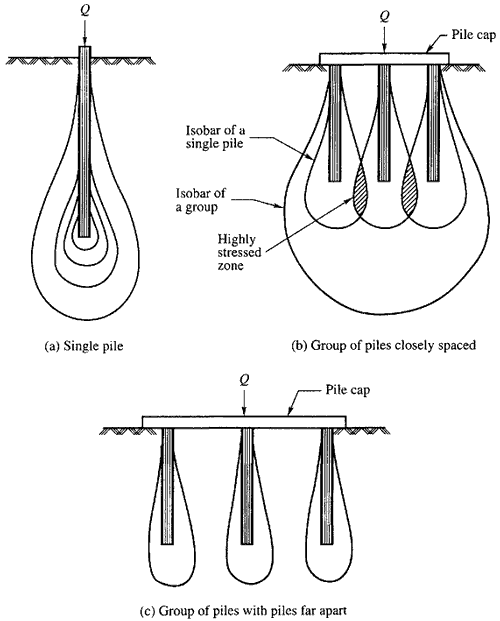
The pressure isobars of a single pile with load Q acting on the top are shown in Fig. 1(a).

When piles are placed in a group, there is a possibility the pressure isobars of adjacent piles will overlap each other as shown in Fig. 1(b). The soil is highly stressed in the zones of overlapping of pressures. With sufficient overlap, either the soil will fail or the pile group will settle excessively since the combined pressure bulb extends to a considerable depth below the base of the piles. It is possible to avoid overlap by installing the piles further apart as shown in Fig. 1(c). Large spacings are not recommended sometimes, since this would result in a larger pile cap which would increase the cost of the foundation.

The spacing of piles depends upon the method of installing the piles and the type of soil. The piles can be driven piles or cast-in-situ piles. When the piles are driven there will be greater overlapping of stresses due to the displacement of soil. If the displacement of soil compacts the soil in between the piles as in the case of loose sandy soils, the piles may be placed at closer intervals.

Figure 1 Pressure isobars of (a) single pile, (b) group of piles, closely spaced,
and (c) group of piles with piles far apart.
But if the piles are driven into saturated clay or silty soils, the displaced soil will not compact the soil between the piles. As a result the soil between the piles may move upwards and in this process lift the pile cap. Greater spacing between piles is required in soils of this type to avoid lifting of piles. When piles are cast-in-situ, the soils adjacent to the piles are not stressed to that extent and as such smaller spacings are permitted.
Generally, the spacing for point bearing piles, such as piles founded on rock, can be much less than for friction piles since the high-point-bearing stresses and the superposition effect of overlap of the point stresses will most likely not overstress the underlying material nor cause excessive settlements.
The minimum allowable spacing of piles is usually stipulated in building codes. The spacings for straight uniform diameter piles may vary from 2 to 6 times the diameter of the shaft. For friction piles, the minimum spacing recommended is 3d where d is the diameter of the pile. For end bearing piles passing through relatively compressible strata, the spacing of piles shall not be less than 2.5d.
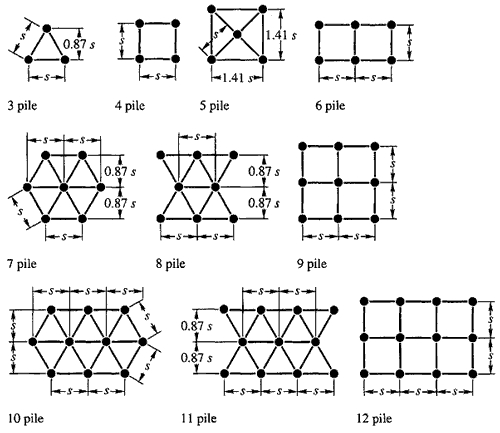
For end bearing piles passing through compressible strata and resting in stiff clay, the spacing may be increased to 3.5d. For compaction piles, the spacing may be Id. Typical arrangements of piles in groups are shown in Fig. 2.
Figure 2 Typical arrangements of piles in groups

GRP vs Traditional Materials

GRP vs Traditional Materials

Comparison of Steel, GRP/Fibreglass and timber

Compare

GRP

Steel

Aluminium

Timber

Corrosion Resistance

Excellent Corrosion Resistance

Can be designed to suit most chemical environments.

Low Corrosion Resistance

Subject to oxidation and corrosion.Requires painting or galvanizing.

Low Corrosion Resistance

Subject to galvanic corrosion. Requires anodizing or other coatings

Low Corrosion Resistance

Can warp, rot and decay from exposure to moisture, water and chemicals. Requires coatings or preservatives.

Weight

Lightweight

(Up to 80% lighter than steel & approx. 30% the weight of aluminium)

Extremely Heavy

Requires heavy lifting gear to manoeuvre.

Lightweight

(about 1/3 that of copper or steel)

Dependent on size

Slip Resistance

Extremely High Slip Resistance

Relinea’s integral grit finish offers the highest degree of slip resistance ever measured for a walking surface, even in wet or oily conditions.

Little or No Slip Resistance

A major health & safety risk for companies.

Little or No Slip Resistance

A major health & safety risk for companies.

Little or No Slip Resistance

A major health & safety risk for companies.

Conductivity

Non-Conductive

No earthing required.

Conducts Electricity

Earthing required.

Conducts Electricity

Earthing required.

Non-Conductive

No earthing required.

Strength

High Strength-to-Weight Ratio

Stronger than steel on a kg-for-kg basis.

High Strength

Heavy in weight to achieve its high strength properties.

Low Strength

Dependent on Size

To achieve reasonable strength properties product sizes have to be extremely large.

Impact Resistance

High Impact Resistance

Will not permanently deform under impact.

Medium to Low Impact Resistance

Can permanently deform under impact.

Low Impact Resistance

Easily deforms under impact.

Medium to Low Impact Resistance

Can permanently deform under impact.

Fabrication

Easily Field Fabricated

Can be easily field fabricated using simple carpenter tools with carbon or diamond tip blades. Lightweight for easier erection and installation.

Fabrication more Complex

Often requires welding and cutting torches. Heavier material requires special handling equipment to erect and install.

Fabrication more Complex

Welding, brazing, soldering or mechanical joining required.

Easily Fabricated

Fabricated using tools such as jigsaws and circular saws.

Maintenance

Maintenance Free

GRP has a design life of 50 yrs.

Constant Maintenance Required

Due to rust, damage, or re-painting. High cost implications.

Constant Maintenance Required

Due to rust, damage, or re-painting. High cost implications.

Constant Maintenance Required

Due to rot, decay, re-painting, or insect attacks. High cost implications.

Cost

Long Term Cost Savings

Lower installation and maintenance costs in industrial applications = very low lifecycle costs.

Low Cost, High Maintenance

Lower initial material cost, however costly to maintain. High lifecycle costs.

Low Cost, High Maintenance

Lower initial material cost, however costly to maintain. High lifecycle costs.

Low Cost, High Maintenance

Lower initial material cost, however costly to maintain. High lifecycle costs.

Ergonomic

Good Ergonomic Properties

The innate elasticity of GRP provides comfort to workers as it has a slight ‘give’ underfoot.

No Ergonomic Properties

Steel does not provide comfort underfoot. Can lead to back ache for workers who are on-foot for long periods of time.

No Ergonomic Properties

N/A

Good Ergonomic Properties

Provides comfort underfoot

EMI/RFI Transparency

Transparent to EMI/RFI transmissions.

Can interfere with EMI/RFI transmissions.

Can interfere with EMI/RFI transmissions.

Transparent to EMI/RFI transmissions.

Aesthetics

Pigments added to Resin

The pigments provide colour throughout the part. No maintenance required. Bespoke colours available.

Painted or Dyed for Colour

To maintain colour and corrosion resistance, repainting may be required.

Painted or Dyed for Colour

To maintain colour and corrosion resistance, repainting may be required.

Primed and Painted for Colour

To maintain colour and corrosion resistance, repainting may be required.

Ground Improvement Techniques | Complete List of Methods | Classifications

Ground Improvement

Ground Improvement or Ground treatment is defined as “controlled alteration of the state, nature or mass behavior of ground materials to achieve an intended satisfactory response to existing or projected environmental and engineering actions”

Ground Improvement by Vibration

Vibration can be used to compact soils and fills. Similar to Vibrating rollers used to compact relatively thin layers of earth fill and bituminous road materials. It involves using vibration to densify the ground in place and to depth either by penetrating the ground with a vibrator or inducing very high level of energy at the ground surface or at defined points within the ground. Major ground treatment methods include;

  • Vibro-compaction
  • Vibro stone columns
  • Dynamic compaction
  • Rapid impact compaction
  • Vibratory probing
  • Compaction piles
  • Blasting

Ground Improvement by Adding Load or Increasing Effective Stress

Applying load on the ground causes it to compress. The extent and time required depends on the arrangement of the ground particles, on the degree of saturation, and on how freely the soil can drain. For loose and particularly unsaturated fills, adding load induces rapid settlement.

Soft, saturated clays take months or years to consolidate under an added load while pore pressures dissipate and the effective stress in the soil increases. Major ground treatment methods include;

  • Pre-compression
  • Vertical drains
  • Inundation
  • Vacuum pre-loading
  • Dewatering fine-grained soils
  • Pressure berms

Ground Improvement by Structural Reinforcement

Many ground improvement methods could be considered as form of reinforcement. Stone columns are introduced materials that stiffen the ground. Major ground treatment methods include;

  • Reinforced soil
  • Soil nailing
  • Root or micro-piles
  • Slope dowels
  • Embankment piles

Ground Improvement by Structural Fill

Basis of this philosophy is to replace a weak soil with a better one. Use lightweight materials instead of heavier earth fills above weak ground is a recent advancement of this method. Major ground treatment methods include;

  • Removal and replacement
  • Displacement
  • Reducing load

Ground Improvement by Admixtures

The use of additives and admixtures, such as lime, cement, oils and bitumen and chemicals like sulphur, is one of the oldest and most widespread methods of improving a soil. Purpose of this method is to strengthen a locally available soil fill to construct a low-cost road base.

Cement stabilized soil or soil-cement, or to mix lime into highly plastic clays is a typical example. Major ground treatment methods include;

  • Lime columns (Swedish method)
  • Lime and cement columns (Japanese method)
  • Mix-in-place by single auger
  • Lime stabilization of slopes
  • Lime stabilization of pavements
  • Cement stabilization of pavement

Ground Improvement by Grouting

Grouting can be defined as controlled injection of material, usually in a fluid phase, into soil or rock in order to improve the physical characteristics of the ground. Major ground treatment methods include;

  • Grouting processes
  • Permeation grouting
  • Hydrofracture grouting
  • Jet grouting
  • Compaction, squeeze and compensation grouting
  • Cavity filling

Ground Improvement by Thermal Stabilization

The removal of heat from the soil turning its pore water into ice is a very powerful technique rendering the ground impermeable and, for unconsolidated materials, making them stronger.

Applying heat to clays to drive out free pore water and, at higher temperatures, the water adsorbed on particle surfaces, creates a very hard, durable material, as when making brick or mud building blocks. Major ground treatment methods include;

  • Artificial ground freezing
  • Artificial ground heating

Ground Improvement by Vegetation

Combining engineering and horticulture, vegetation as ground improvement is the biological reinforcement of soil by plant roots to retain earth masses and prevent soil loss.

Epoxy Resin vs. Vinylesters and Polyester

Here is some technical data that you may find interesting regarding the differences between Epoxy Resin and Vinylester or Poyester Resins. 

In the marine industry, liquid plastics, namely epoxies, polyesters, and vinylesters are used to saturate (wet out) the fibers of wood, glass, kevlar amarid, or carbon to form a fiber reinforced plastic (FRP).  To create a quality part, adhesion to the fibers is the most important factor.  Not all resins keep their grip on fibers equally.

Epoxy resin is known in the marine industry for its incredible toughness and bonding strength.  Quality epoxy resins stick to other materials with 2,000-p.s.i. vs. only 500-p.s.i. for vinylester resins and less for polyesters.  In areas that must be able to flex and strain WITH the fibers  without micro-fracturing, epoxy resins offer much greater capability. Cured epoxy tends to be very resistant to moisture absorption.  Epoxy resin will bond dissimilar or already-cured materials which makes repair work that is  very reliable and strong.  Epoxy actually bonds to all sorts of fibers very well and also offers excellent results in repair-ability when it is used to bond two different materials together.

Vinylester resins are stronger than polyester resins and cheaper than epoxy resins. Vinylester resins utilize a polyester resin type of cross-linking molecules in the bonding process.  Vinylester is a hybrid form of polyester resin which has been toughened with epoxy molecules within the main moleculer structure.  Vinyester resins offer better resistance to moisture absorption than polyester resins but it’s downside is in the use of liquid styrene to thin it out (not god to breath that stuff) and its sensitivity to atmospheric moisture and temperature.  Sometimes it won’t cure if the atmospheric conditions are not right.  It also has difficulty in bonding dissimilar and already-cured materials.  It is not unusual for repair patches on vinylester resin canoes to delaminate or peel off.   As vinylester resin ages, it becomes a different resin so new vinylester resin sometimes resists bonding to your older canoe. It is also known that vinylester resins bond very well to fiberglass, but offer a poor bond to kevlar and carbon fibers.  Do to the touchy nature of vinylester resin, careful surface preparation is necessary if reasonable adhesion is desired for any repair work. 

Polyester resin is the cheapest resin available in the marine industry and offers the poorest adhesion, has the highest water absorption, highest shrinkage, and high VOC’s.  Polyester resin is only compatible with fiberglass fibers and is best suited to building things that are not weight sensitive.  It is also not tough and fractures easily. Polyesters tend to end up with micro-cracks and are tough to re-bond and suffer from osmotic blistering when untreated by an epoxy resin barrier to water.  This is really cheap stuff.

Summary – Epoxy resin has far more to offer in its ability to flex, prevent delamination, and ease of use for repairwork. Using epoxy resin leads to better quality products.

Scaffolding Tubes

Scaffolding Tube – Steel Tube is supplied in 48.3mm Outside Diameters (O/D) and is manufactured to BS EN 1139 European standard.

Scaffolding Tube – Steel Tube is Hot Dipped Galvanised to BS EN 10240 standards and has a wall Thickness of 4.0mm.

Scaffolding Tube – Steel Tube is supplied in various lengths including:
20ft (6.1Metres), 16ft (4.88 Metres), 13ft (3.96 Metres), 10ft (3.05 Metres), 8ft (2.44 Metres), 7ft (2.13 Metres), 5ft (1.52 Metres), 4ft (1.22 Metres), and 3ft (0.91Metres).

Free Cutting Service – Up to 20 cuts free, then a cutting charge will apply, minimum charge £15 ex Vat

Scaffolding Tube is specified for all Load Bearing Scaffolding structures where personnelare involved. We also offer Aluminium Scaffolding Tube – Alloy Tube in 48.3mm O/D in various lengths including 6m, 3m, 2m, 1.5m & 1.0m.

Properties and capacities
Properties of standard scaffold tubes
in accordance with TG20 / BS 5973: 1993 / BS 1139 – 1.2 / BS EN 12811-2
Outside diameter =
Wall thickness =
Cross sectional area =
Mass =
Inertia =
r =
Zp (S in TG20) =
Ze =
Allowable bending moment =
Allowable shear =
Min yield strength =
Modulus of elasticity =
Steel tube (as new U.N.O.):
48.3 (+/- 0.5) mm
4.0 (+0.47/-0.4) mm
5.57 cm2
4.37 kg/m
13.8 cm4
1.57 cm
7.87 cm3
5.7 cm3
1.12 (used tubes: 0.99) kNm
26.1 (used tubes: 23.3) kN
235 N/mm2
210000 N/mm2
Aluminium tube:
48.3 (+/- 0.5) mm
4.47 (+0.56) mm
6.15 cm2
1.67 (-7.5%) kg/m
14.9 cm4
1.56 cm
8.61 cm3
6.18 cm3
1.33 kNm
25.5 kN
255 N/mm2
70000 N/mm2
Allowable scaffold tube strut loads
(based on ‘as new’ scaffold tube as given above) in accordance with TG20
Effective length:
0.6 m
0.8 m
1.0 m
1.2 m
1.4 m
1.6 m
1.8 m
2.0 m
2.2 m
2.4 m
2.6 m
2.8 m
3.0 m
3.2 m
3.4 m
3.6 m
3.8 m
4.0 m
Safe axial load:
Steel tube
70.9 kN
65.0 kN
58.6 kN
51.9 kN
45.3 kN
39.2 kN
33.7 kN
29.1 kN
25.3 kN
22.0 kN
19.3 kN
17.1 kN
15.2 kN
13.6 kN
12.2 kN
11.0 kN
10.0 kN
9.1 kN
Safe axial load:
Aluminium tube
79.3 kN
64.8 kN
48.9 kN
36.5 kN
27.9 kN
21.8 kN
17.5 kN
14.4 kN
12.0 kN
10.1 kN
8.7 kN
7.5 kN
6.6 kN
5.8 kN
5.2 kN
4.6 kN
4.2 kN
3.8 kN
Properties of scaffold boards
in accordance with TG20 / BS 2482:1981
Width =
Thickness =
Mass per unit length =
Mass per unit area =
Max support =
Min section modulus =
Allowable B.M. (1 board) =
Allowable B.M. (4 boards) =
Board overhand – min =
Board overhand – max =
Standard
225 mm
38 (+/- 2) mm
6 kg/m
25 kg/m2
1.2 m (+100mm)
47.5 cm3
0.48 kNm
0.71 kNm
50 mm
150 mm
Super Boards
225 mm
38 (+/- 2) mm
6 kg/m
25 kg/m2
1.5 m (+100mm)
47.5 cm3
0.63 kNm
1.01 kNm
50 mm
150 mm
Omega Timber Batten
225 mm
63 (+/- 3) mm
10 kg/m
41 kg/m2
2.5 m
132 cm3
1.30 kNm
1.30 kNm
50 mm
250 mm
Scaffold coupler safe working loads
in accordance with TG20 / EN 74 / tests by others
Coupler type:
Right angle coupler (Class A) =
Right angle coupler (Class B) =
SGB MK3A right angle =
Swivel coupler (Class A) =
Sleeve coupler (Class A) =
Sleeve coupler (Class B) =
Parallel coupler (Class B) =
Putlog coupler =
SGB Brace D/H =
Spigot pin =
Adjustable base / FH =
Slipping force
6.1 kN
9.1 kN
12.5 kN
6.25 kN
3.60 kN
5.45 kN
6.10 kN
0.63 kN
5.0 kN

Shear


21 kN
Axial


30 kN
Steel Scaffold Beams
in accordance with BS 449 / BS 5973
Beam type:
Ladder
Unit
Layher 450 mm
Layher 750 mm
Iyy
2600.0 cm4
10572.0 cm4
4481.0 cm4
13702.0 cm4
Self weight
0.1275 kN/m
0.1300 kN/m
0.1000 kN/m
0.1600 kN/m
Max allowable B.M.
13.70 kNm
27.70 kNm
24.98 kNm
55.16 kNm
Max allowable shear
18.0 kN
20.0 kN
18.54 kN
27.27 kN
Modulus of elasticity = 210000 N/mm2
NOTE: Beam capacity is a function of spacing of lateral bracing. This to be provided in accordance with manufacturer’s specification.

Aluminium Scaffold Beams
based on manufacturers’ specification

Beam type:
Combisafe Ubix 450
ASP 610
ASP 750
Combisafe Ubix 780
Haki 450
Haki 750
Layher 450
Layher 750
Rux 450
Apollo Cradle X
Iyy
4957.86 cm4
16563.1 cm4
17340.8 cm4
17340.8 cm4
4483.0 cm4
17182.0 cm4
4481.0 cm4
15195.0 cm4
not given
not given
Self weight
0.045 kN/m
0.060 kN/m
0.060 kN/m
0.060 kN/m
0.050 kN/m
0.074 kN/m
0.050 kN/m
0.060 kN/m
not given
not given
Max allowable B.M.
19.60 kNm
18.50 kNm
43.80 kNm
36.50 kNm
15.70 kNm
41.90 kNm
13.94 kNm
42.50 kNm
18.12 kNm
42.90 kNm
Max allowable shear
17.10 kN
24.00 kN
31.50 kN
30.70 kN
12.70 kN
30.60 kN
12.32 kN
25.60 kN
9.70 kN
45.40 kN
Modulus of elasticity = 70000 N/mm2
NOTE: Beam capacity is a function of spacing of lateral bracing. This to be provided in accordance with manufacturer’s specification.
NOTE: ASP was bought by Combisafe and now only Ubix 450 (previously ASP 450) and Ubix 780 (previously ASP 780) are available. Other ASP sizes are listed for reference.
Main scaffolding terms
Anchor – an element that transfers forces between a scaffolding tie and a supporting structure. Can be temporary or permanent.
Base Plate – a rigid plate under a standard, used to spread reaction.
Bay – space between two adjacent standards along face of a scaffold.
Bay Length – distance between centres of two adjacent standards.
Coupler – an element that connects two scaffold tubes together.
Ledger – a longitudinal scaffold tube (normally) parallel to a building face. Supports putlogs or transoms, and frequently for ties and ledger braces. Usually connected to adjacent standards. Perpendicular to transoms.
Putlog – a scaffold tube with flattened end. Rests in or on part of a brickwork structure.
Safe working moment – is a characteristic moment of resistance divided by a factor of safety.
Scaffold tube – any tubular element of a scaffold: standard, ledger, transom etc.
Standard – a vertical scaffold tube.
Swivel coupler – a coupler for joining tubes at an angle (i.e. other than at a right angle).
Tie – connects a scaffold to an anchor.
Transom – a scaffold tube spanning across ledgers and supporting scaffold boards forming a working platform or connecting outer standards to inner standards. Perpendicular to scaffold boards.
Working load – a load that can be safely carried by a structural member.


Shear Deflection in Beams

Shear stresses in a beam section cause a displacement or sliding action on a plane normal to the axis of the beam. This is unlike the deflection resulting from bending in a beam.

Normally deflection due to shear in the usual beam is ignored because it represents a very small percentage of the entire deflection. The deflection due to shear increases linearly as the length of the beam increases, whereas the deflection due to bending increases very rapidly as a third power of the length of the beam. For this reason the deflection due to shear is not an important factor except for extremely short spans where deflection due to bending drops off to a very small value.

In Graitec Advance Design, the linear element type includes beam and specially a ‘short beam’. The difference between these two types is the ‘beam’ type ignore shear deflection while ‘short beam’ type take that into account.

Linear and nonlinear analysis in structural analysis programs

Linear Analysis

What is linear analysis? A proportional analysis. For example if I say that a moment M is generating a deflection of D, and what would be the moment acting on the beam if the deflection is 2D? It will be 2M. Quite simple right? This analysis is called linear analysis. All the principle of superposition are also valid.

Let us say dead load is causing a beam deflection the beam by 1″ and live load is causing a deflection of 0.5″ and if I ask you what will by the sum of deflection cause by the two loads? It will be 1 + 0.5 = 1.5″. This is pretty simple, principle of superposition.

This all can happen because the stresses are proportional to strains. Take an example of mathematical equation of a straight line.

y=mx

Now if I say that the value of slope is known and I give a particular value of x, can you figure out the value y? Of course yes. And this can be done in a single step. No repetition is required. Now replace x with strain and y with stress and m is the stiffness of material. The equation of the same straight line becomes:

σ=Es ϵ

So this is why linear analysis is simple. If you know the deformation for 1 unit of load and if you wish to find out the deformation for 5 units of load, you just multiply the deformation by 5 and you have your results. This will reduce the time and effort put into analysis. It will give you sometimes conservative results and sometimes inaccurate as well. (I will justify inaccurate in Nonlinear analysis)

Whatever we lean in under grad is linear analysis. You calculate the forces, you design the section and you are done. We do not consider any cracking effects not do we look for strength loss.

We are still doing linear analysis because we also consider material safety factors and specified properties. The actual strength of material is actually greater than the specified strength and specified strength is the strength without considering any factors of safety.

Nonlinear analysis

  1. Material Nonlinearity

When the materials move into the zone beyond it’s yield strengths, it no longer behaves in a linear fashion. There are many things that happen when material go into this zone:

  • Permanent deformations: This means that when the material is unloaded it will not go back to it’s original shape or position. For example if you take a plastic bag and stretch it, after a certain point even if you release the bag you will see the permanent stretch marks. This is called permanent deformation.
  • Cracking: Generally this occurs in linear design as well, but we neglect the cracking of concrete, even though we still consider the reduced stiffness of members while doing seismic design, but still it is an assumed value. While in nonlinear analysis we monitor the cracking and so concrete will crack and member will start losing its stiffness.
  • Beam rotations: When a beam is subjected to moments greater than it’s capacity, it no longer resists the moments, instead it rotates and forms a plastic hinge and start dissipating energy. This is a part of material nonlinearity but for beams it is called backbone curve (aka F-D relationship). In case of linear design we do not case for anything greater than the capacity of the member.
  • Energy Dissipation: In linear analysis, energy dissipation is in the form of strain energy, while in case of nonlinear analysis it is in the form of inelastic energy in addition to strain energy dissipation.

 These were a few generalized things that came to my mind while looking at nonlinear analysis.

This is what happens in nonlinear analysis. If a member goes beyond its capacity (elastic limit), it will experience some sort of strain hardening or cracking and it will start losing its stiffness which also means that the total stiffness of the structure or building is also changing. Thus what you do is, you load the structure and see if it went into nonlinear stage, if it does then we see how much the material has cracked also know as softening of structure. If the loss in stiffness is significant and the results or the energy balance do not converge, we iterate the same process and do the analysis again. This cycle will go on till the desired accuracy is achieved. Thus a nonlinear analysis takes longer than a linear analysis because of such loses in stiffness and its iterative nature. But this was talking about a nonlinear static analysis.

As I mentioned before, a linear analysis cannot give a complete picture as what can happen to the structure if an earthquake hits. Today we have the ability to create a mathematical model which to around 90% of the accuracy can give us results which again depends on modelling assumptions and the detail at which it is done. But it gives us an idea whether everything is okay or not. But to everyone’s utmost surprise, the linear dynamic analysis gives a far off result. For example, in case of a beam which is subjected to earthquake shakes. It will experience some force but that force is limited. And we design the beam to that limited force. When we check the same beam for actual earthquake (The one which is not limited) and see check the beam, many times structural engineers find that the beam is actually getting shattered. Now with increased load we definitely expect some rotations but shattering of beam is just not acceptable.

So this is the benefit of nonlinear analysis over linear analysis.

2. Geometric Nonlinearity

The most famous geometric nonlinearity is P-Delta analysis. A force follower approach. (I am copying the data from my other answer over here)

P Delta analysis is quite a traditional form of force follower analysis. It is also called “Geometric Nonlinearity” because as the deflection increases you again have to test the additional forces generated by P-delta effects. A force follower analysis is the one in which, when a member loses its stability the force follows the deformed member and creates further more instability very quickly. A P-Delta analysis is not as simple as it sounds and its effects will be very adverse if neglected. These effects will be more severe in case of soft lateral force resisting systems  like moment frames as compared to stiff systems like core wall systems and braced frames.

Talking about P-Delta, P delta is a term coined from P that is load and delta is the lateral deformation. These lateral deformations are more lethal in case of earthquakes and not so much in case of wind.

What is the significance of it’s study? Is it just limited to design of columns? Something like this:

What it does is, it generates additional shear forces and bending moments in columns because of the deformed shape. The moments generated will be equal to the load acting on the column times the horizontal displacement. Now we have to check the column capacity particularly in case of slender columns so that they do not fail in case of these additional moments along with the axial loads. This can be checked with P-M interaction diagram of the column cross section.

Just make sure that the load point lies inside the P-M interaction boundary of the column.

In addition to this, the P-Delta effects has one more adverse effects, specifically in tall buildings. As we know, in case of earthquake a building deforms. And this deformation is huge and the structure is already in its inelastic zone with concrete cracking. This means that the structure is already losing its stiffness. Now the P-Delta shear (The force that is generated at the top and bottom of the column because of P-delta moments), generates an additional demand for lateral shear resistance of the structural system. This additional demand is in addition to the earthquake shear demands. Which means that if we have not consider the P-delta demands and if we provided in sufficient shear resistance, than the building might collapse, similar to this:

As you can see, it is very severe.

Now, the effect of P-Delta shear demands is more in case of moment resisting frames as compared to shear core systems. The reason is, moment frame is already moment governed and so it is a soft system. A soft system tends to drift more in case of lateral load and more drift means more “delta” which means more shear and moment demands because of the P-delta effects. While in case of shear core, the structural system itself is very stiff and as the name suggests, a shear core system is resisting shear forces so it will not impact the structural system to a great extent.

Refer to chapter 2.3 in the following guidelines for more understanding of P-Delta effects as they will show you some charts of strength deterioration of the system.

http://peer.berkeley.edu/tbi/wp-…


Now how does a computer program deals with everything? Do we have to do something special to do nonlinear analysis? Or all computer program does that by default?

By default, a computer program is set for linear analysis. Quick and easy method and for most of the small structures it will be more than good approach.

Can the same model be used for nonlinear analysis? No, you will have to add a ton of information into the computer model to do nonlinear analysis. You will have to add stress strain curve for concrete, for steel. You will have to define backbone curves for beams. You will have to define P-M-M back bone curves for columns. You will have to define fiber elements for shear walls. You will be defining P-delta columns. You will be defining the limit states. The back bone curves for coupling beams for different aspect ratios are different. So all in all, to create and test one nonlinear model, it will take you about a month. Analysis will take a day. And processing the results will take another day.

What does program do is. It will start with the initial stiffness of the building which is right because before a building is loaded how can there be any cracks and loss in stiffness? Then the building is loaded with incremental loads. And it will go on increasing the loads till it reaches the limit of linearity. As soon as it hits the nonlinear zones, it will start iterating the model. Load the structure calculate the strains and deflections and stiffness. Loss in stiffness -> Yes? Iterate the same step. Loss in stiffness -> No? Go to the next load step and so on.


Nonlinear analysis is a complex task. It is the best example of “Half knowledge” is dangerous. If you do not know anything about nonlinearity then first learn it and then perform analysis. If you do it before that you will set up incorrect model and you will not be able to interpret the results.

I hope I gave you some idea about nonlinear analysis. There is much more to this. I cannot even describe how vast this topic gets. But for the purpose of a general answer, I think I did my best to explain you in a Nutshell.

http://www.thestructuralmadness.com/p/home.html

非线性问题分类及求解

线性linear,指量与量之间按比例、成直线的关系,在空间和时间上代表规则和光滑的运动;非线性non-linear则指不按比例、不成直线的关系,代表不规则的运动和突变。

非线性问题分类

 当材料是线弹性体,结构受到载荷作用时,其产生的位移和变形是微小的,不足以影响载荷的作用方向和受力特点。静力平衡方程表示为:
其基本方程的特点如下:
非线性问题分类及求解
  • a.材料的应力与应变,即本构方程为线性关系。

  • b.结构应变与位移微小、即几何方程保持线性关系。

  • c.结构的平衡方程属于线性关系,且平衡方程建立于结构变形前,即结构原始状态的基础之上。

  • d. 结构的边界(约束)条件为线性关系。

  • 不同时满足上述条件的工程问题称为非线性问题。

    习惯上将不满足条件a的称为材料非线性;不能够满足条件b、c的称为几何非线性;不满足条件d的称为边界非线性 。对于兼有材料非线性和几何非线性的问题称为混合非线性问题 。 对于上述非线性问题总可归结为两大类,即材料非线性和几何非线性。

    END

非线性问题求解

   非线性问题用有限单元法求解的步骤和线性问题基本相同,不过求解时需要多次反复迭代,基本三大步骤如下:
 (1) 单元分析
非线性问题与线性问题的单元刚度矩阵不同,仅为材料非线性时, 使用材料的非线性物理(本构)关系。 仅为几何非线性时, 在计算应变位移转换矩阵[B]时, 应该考虑位移的高阶微分的影响。 同时, 具有材料和几何非线性的问题,受到两种非线性特性的藕合作用。
(2) 整体刚度矩阵集成
整体刚度矩阵集成、平衡方程的建立以及约束处理,与线性问题求解相似 。
(3) 非线性平衡方程求解
对于几何非线性问题,平衡方程必须建立在变形后的位置,严格来讲是建立在结构的几何位置及变形状态上,简称为位形状态。因而,非线性问题的平衡方程表为
非线性问题分类及求解
求解的方法按照载荷的处理方式可分为全量法和增量法两大类。

Cast Iron versus Wrought Iron

What’s the difference—and how are they used?

Many people think the term “cast iron” refers to all early iron work, or that early iron work was always “wrought.” These are misconceptions, and the basic distinction between the two is simple:

  • Cast iron is iron that has been melted and poured into a mold and allowed to cool
  • Wrought iron is iron that has been heated and then worked with tools

In other words, their names define how they’re formed. But that’s a simple distinction. Let’s look a bit more in-depth into the more significant differences between them—and what this means for their overall use and application.

Many of our decorative bollards have been cast using a newer form of cast iron called “ductile iron,” which offers many benefits of both cast iron and wrought iron—without the drawbacks.

What is cast iron?

Cast iron is a generic term that can refer to a range of iron alloys, but is typically associated with the most common gray iron. While cast iron may sound like the cast form of the pure element iron (FE on the periodic table), it’s actually an alloy containing 2–4 percent carbon, plus additional amounts of silicon and manganese. Other impurities, such as sulfur and phosphorus are also common.

Cast iron is formed by smelting iron ore, or melting pig iron (the product of iron ore extraction), and mixing with scrap metals and other alloy ingredients. The liquid mixture is then poured into molds and allowed to cool and solidify. Due to its higher carbon content, cast iron solidifies as a heterogeneous alloy—meaning it contains multiple constituents, or materials in different phases, within its microstructure. This quality affects its physical properties as well.

Cast iron, when compared to wrought iron or steel, is very brittle and comparatively hard and non-malleable. It can’t be bent, stretched or hammered into shape. Its weak tensile strength means that it will fracture before it bends or distorts. It does, however, feature good compression strength, and was used prominently in building construction before the advent of steel industries in the early 20th century.

Compared to steel, cast iron has a lower melting point, is more fluid and is less reactive with mold materials—making it ideal for casting. Casting is significantly less labor-intensive than manufacturing wrought iron, and was a prominent form of production throughout the 18th and 19th centuries. Cast iron has largely been replaced by steel in the construction industry, but it is still used for many industrial applications.

What is wrought iron?

As mentioned above, cast iron and wrought iron are often defined by how the materials are formed. But they differ also in their material composition. Wrought iron is composed primarily of iron with small amounts (1–2 percent) of added slag (“slag” being the by-product of iron ore smelting, generally consisting of a mixture of silicon, sulfur, phosphorous and aluminum oxides). During manufacture, the iron is removed from heat and worked with a hammer while still hot to achieve its intended form.

Cast iron is very brittle in nature, meaning it’s comparatively hard and non-malleable

Wrought iron is often characterized by its fibrous appearance, but it’s also softer and more ductile compared to cast iron. Wrought iron is highly malleable, meaning it can be heated, and re-heated, and worked into various shapes—and in fact grows stronger the more it’s worked. The word “wrought” actually derives from the past participle of the word “work.”

In terms of how it’s used, wrought iron has a much higher tensile strength than cast iron, making it more suitable for horizontal beams in construction. In general, it is highly resistant to fatigue. It will deform without failing, unless overloaded beyond capacity or distorted from exposure to intense heat (i.e. from fire).

Wrought iron was used as early as 2000 BC in the Anatolian peninsula (now Turkey). More recently, it was widely used throughout the 19th century in building construction, but was ultimately replaced by steel in the 20th century. Today, wrought iron is used primarily for decorative applications—but even so, mild steel is often cheaper and more practical for achieving a wrought iron aesthetic.

Ductile iron: Strength and versatility

The problem with cast iron is that, within its microstructure, carbon particles form elongated graphite flakes when cooling. Graphite is low in density and hardness but high in lubricity. What does this mean? Not only does it offer little structural advantage, it also compromises the surrounding iron matrix—creating internal stress points that are conducive to fracture.

Ductile iron is a unique form of iron developed by researchers during the 1940s. They discovered that by adding select alloys—initially a magnesium-copper alloy, and eventually cerium—they could manipulate carbon atoms to form spheroidal graphite. Within the iron microstructure, these spheroidal shapes prevent cracks from forming—which is what makes ductile iron such a versatile material.

Ductile iron can be manufactured to multiple grades to achieve high ductility and tensile strength. Austempered ductile iron, produced with additional heat treatment, has even better mechanical properties and resistance to wear. Ductile iron is also ideal for casting, as it doesn’t have the shrinkage properties of steel. This makes for more precision in design and avoids the use of large feeders to offset material loss. Ductile iron is often used “as-cast,” meaning it doesn’t require heat treatments. This can help reduce manufacturing costs—especially over the long term.

Corrosion considerations

Ductile iron can be manufactured to achieve high ductility and tensile strength

Cast iron and wrought iron are both susceptible to corrosion when bare surfaces are exposed to oxygen in the presence of moisture. This can be challenging for outdoor environments where exposure to precipitation and humidity can be ongoing. Unlike other metals that form a protective oxidative coating, iron will—given enough time—rust and flake away entirely.

To prevent rust, iron products should be coated to prevent exposure. Paint is commonly used to coat and protect bare metal. Powder coating is another method—ideal for outdoor furnishings more susceptible to wear in high-traffic areas. Powder coatings are highly durable and won’t fade, chip or crack over extended periods of time.

Historical preservation

From Lincoln, Massachusetts to Lincoln, Nebraska to Lincoln, Ontario, North America is rich with history. Every town has a story to tell, and the buildings in these towns have played as much a part in crafting the past as the people themselves.

When restoring historical buildings with architectural iron and metalwork, quality and authenticity is critical. Large outdoor elements such as bollards, gates, fences, lamp standards and park benches play a significant role in setting an ambience faithful to historical times. Modern foundries can reproduce early metalwork by taking their design cues from drawings or the original structures themselves. Existing cast metal furnishing designs can also be suitable, cost-effective means for revitalizing surrounding areas.

Sources

What is the Difference Between Epoxy and Polyester Resin?

When you begin to compare the many forms and variations of epoxies, glues, and resins available today, the results may leave you scratching your head. One question often leads to another. The chemistry behind epoxy and the varying formulas of glue has come quite a long way over the years, and can be a bit intricate. So what is the difference between each product? 

Common Question

Here is a simple question that we often encounter from DIY folks who find the need to make product choices:

“What is the difference between your PC- Epoxy products and the polyester resins found online or in hardware stores?”

Good question!

Epoxies and resins are adhesives commonly used in home, automobile, aircraft, and boat building repairs. They are also gaining ground as go-to DIY craft and jewelry materials. But, there are several key differences between epoxies and resins.

Key differences between epoxies and resins

1. Bonding Strength

Epoxy is known for its higher bonding capabilities overall. An epoxy’s relative strength can hold up to 2,000 lbs. per square inch, while a polyester resin can hold less than 500 lbs. per square inch.

2. Resistance to Wear

Epoxy is more resistant to wearing, cracking and peeling, and corrosion or damage from chemical or environmental degradation. Polyester is more fragile and useful for temporary fixes, or low-stress use.

3. Cost Comparison

Epoxy is generally more expensive than resin, due to its strength and formulation requirements. Resin is more popular for craft and jewelry making,due to its lower cost. Remember, however, that you get what you pay for.

4. Resistance to Moisture

Epoxy is very moisture resistant, and certain formulations can even be applied underwater.  Polyester resin has minor resistance to moisture, is considered water-permeable, and can fracture easily.

5. Cure Time

Although cure times vary for both epoxy and resin, depending on the formulation and temperature at use, resin generally has a faster cure time. This can be good or bad, depending on the speed with which you want to finish your project. Both products can be manipulated somewhat by raising or lowering the temperature before use. Certain epoxies are also formulated for use in extreme temperatures.

6. Odor

Polyester is far less pleasant to work with than epoxy. Although it sets up much faster, it has the reputation for stinking badly enough to burn your nose hairs out. Make sure to use proper ventilation when applying both epoxies and resins.

7. Shelf Life

There is no doubt about it – epoxy products have a much longer shelf life than resins do. As long as it hasn’t been mixed, epoxy can sit in a garage for several years (or more) without losing its potency. Resin is much more fragile over time.